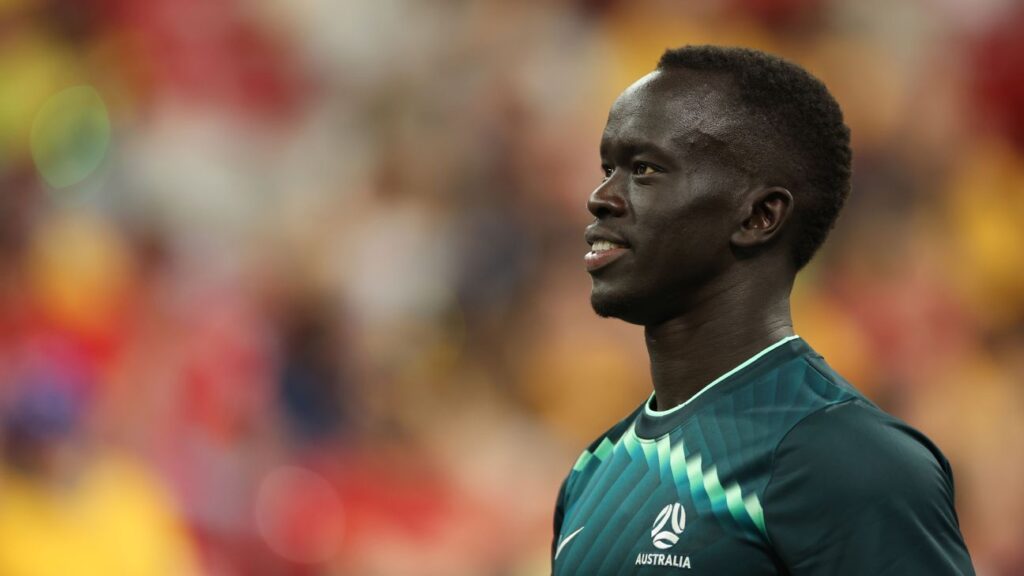
ALAMEDA, California — Awer Mabil believes that a viral video documenting the diversity of the Socceroos found an audience in an Australian community that saw their own experiences reflected in it. And in Refugee Week, the South Sudanese-refugee has sent a message to displaced people the world over that they are not alone, and that “everything is possible.”
Mabil, 30, was front and centre in a video distributed by Australian players’ association Professional Footballers Australia on the eve of the FIFA World Cup, one in which members of the Socceroos squad detailed their diverse backgrounds, how that made the side represent Australia, and how it served as their strength.
“I think it was a moment to describe what Australia is,” Mabil said of the PFA video. “Australia is a very multicultural country, and that’s what makes it the best country in the world. In my opinion, it’s the best country in the world, because of that. You have the whole world in one place.
– Tan: Asia has come to play at the World Cup
– Socceroos World Cup Daily: Has Australia been underrated?
– How to watch the Socceroos, fixtures, results, all you need to know
“And the Socceroos now are a representation of that; you have many different backgrounds representing one jersey. So, for me, it was an easy thing to do. As players, we all have different stories, and we all came together.
“The reason why it went viral is because it was raw, it was not edited, it was just purely what the players wanted to say, and all put together. Then it had an effect, because individually the Australians can feel and relate with it.”
While not as pointed as their message on the eve of the 2022 World Cup in Qatar, in which they highlighted the rights of migrant workers and LGBTQIA+ people, the subtext of the message was clear.
“At a time when some seek to divide us and question who belongs, the Socceroos stand as a powerful reminder of who we truly are,” PFA chief Beau Busch told ESPN. “The Socceroos reflect the very best of modern Australia: a diverse, multicultural team, where every player brings a unique story of heritage, family and belonging.
“The video was designed to be a powerful reminder that our strength as a national team comes from that diversity, and the communities and cultures that continue to shape the game in this country, including the refugees and their incredible stories of hardship and resilience.”
Playing at his second World Cup, Mabil was born in Kakuma, Kenya, to South Sudanese parents and lived in a refugee camp until he was 10-years old, where he and the other children would play football with a rolled-up sock serving as a ball. Securing a humanitarian visa and moving to South Australia, Mabil broke into the senior team of Adelaide United during the 2012-13 season and went on to make nearly 50 appearances for the Reds before moving to Danish outfit FC Midtjylland.
He is one of three members of the Australian squad who arrived in South Australia as refugees, alongside striker Mohamed Touré and winger Nestory Irankunda, who made history last Saturday when he netted in the side’s 2-0 win over Türkiye and became the youngest Socceroo to ever score at a World Cup. Defender Miloš Degenek fled his home in Knin, Croatia and lived as a refugee in Serbia for six years before his family migrated to Sydney.
Mabil spoke to the media on the second day of Refugee Week, with Refugee Day set to be observed in Australia on Saturday.
“It’s a coincidence that it’s Refugee Week during the World Cup, and that, also at the same time, you have many refugees in the [Socceroos],” he said. “When I reflect back, we all belong to this world together, we’ve all just got to thank Australia and do our very best for the country that has taken in so many refugees over the years and has done that for a long time.
“Now, we’re representing Australia. From our background, I have a story of how there was war in my country, so my parents fled my country, and then Australia took us in through a humanitarian visa. That’s how I was able to go to Australia, and many others have their way of going to Australia, and their reasons.
“For me, it’s Refugee Week. It’s a week that I would like to say to anybody who is misplaced all over the world that you know we are with you, and we are on a world stage right now, in a big tournament, and just to tell you, everything is possible, so keep going.”