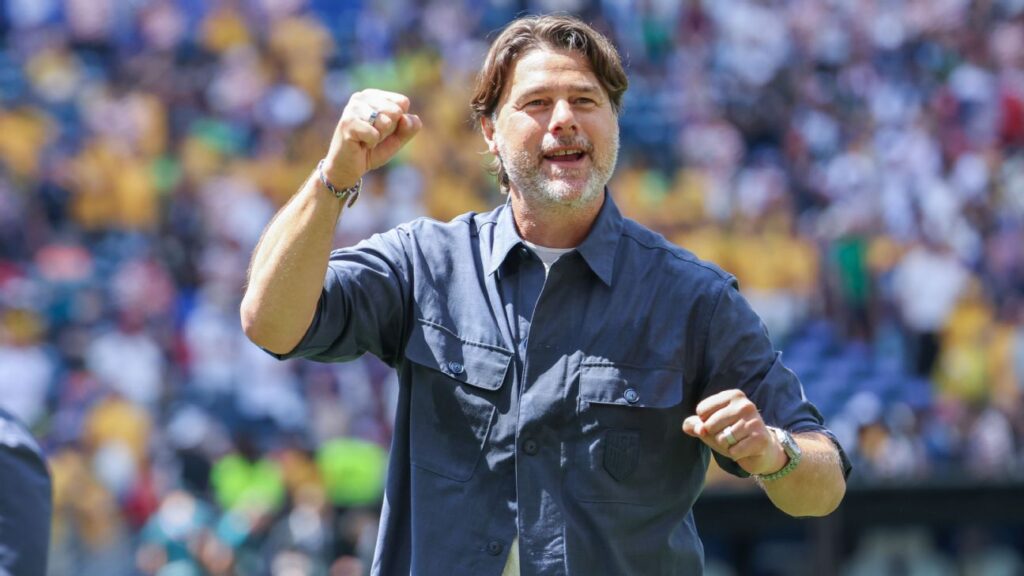
LIGUNA NIGUEL, Calif. – United States men’s national team manager Mauricio Pochettino said he and his staff were “naïve” when he first signed his contract with the U.S. Soccer Federation in 2024, and that the complacency around the program felt like a “big punch.”
Pochettino and the USMNT are flying high at the World Cup, having already clinched the top spot in Group D with one game to spare, that being Thursday’s group stage finale against Turkiye. The team has looked strong in its first two matches, a 4-1 hammering of Paraguay and a more difficult 2-0 triumph over Australia.
But when Pochettino first arrived following the team’s group stage elimination at the 2024 Copa America, he was surprised at the lack of energy around the program.
“We were so naïve when we signed our contract,” Pochettino said on Tuesday night during a roundtable with reporters.
“I think what we find after we sign, we misjudged the situation. It was worse than we really believed.” He said that he thought people would be “desperate to help, to help everyone to be involved, come to the national team. No. It was the opposite.” He added, “We received a big punch…We said, ‘What the f—?'”
Pochettino made his comments in his office at the team’s hotel, with favorite phrases like “Believe. Work. Compete” and “Now Is Our Time” and a giant “Why not U.S.” on the wall behind him. He explained that after the initial shock wore off, he and his staff embarked on what he calls “a process”, where they went about analyzing the squad, finding new players like defender Alex Freeman and midfielder Sebastian Berhalter, and rekindling a passion for the USMNT.
He stuck with his approach, even as results — like the two losses at the 2025 Concacaf Nations League final — created doubt about his methods. Pochettino added that the punch from that competition was expected.
“I think it was more a plan to have this punch that was painful, but was necessary,” he said. “Even for the player to realize that in this way it’s impossible. It’s impossible to arrive in a good condition to the World Cup.”
Pochettino went about creating a culture where there were no guaranteed spots, reputations counted for little, and everything had to be earned. But it took time.
“It’s difficult to analyze the process…like when you put the seed on the soil first thing, you don’t see nothing, and then you start to grow the tree,” Pochettino said. “And it was difficult to explain the plan because it’s not easy. It’s not like a football club that you [see] every day and you have every three days [a chance] to show that you progress.” He added, “If you see all the process, [it] was a process that was necessary, necessary to change.”
Along the way, Pochettino began to instill some self-belief in the team. Pochettino recalled that in a team meeting in November of 2025, he was explaining how South Korea reached the semifinals of the 2002 World Cup as co-hosts, and Morocco made a surprise run to the semis in 2022. He felt the U.S. could reach similar heights.
“In this moment I was like, ‘Okay, why not us?'” he recalled. “And then they were [shocked]. ‘Why not us?’ It was like a motto for us to say, ‘We can. If we believe we can, we can do. If we work hard, we can do. If we change our mindset, we can do.'”
In addition to the improvement in the team, Pochettino said he has also noticed a greater connection with the fans. He remembered how it was “painful” to have 70,000 fans of Mexico fill the stadium at the 2025 Gold Cup final. Now the vibe is different. The crowd support, not only in the two World Cup games, but in the two pre-World Cup friendlies has been off the charts. The team being serenaded in Seattle with the song “Take Me Home, Country Roads” struck a chord with the players and staff. Pochettino said he is learning the lyrics.
“That was nice in Seattle to listen to your own culture appear,” he said, adding, “That is the most important legacy, the connection between the national team and the fans.”
Pochettino has been linked with numerous European jobs throughout his U.S. tenure. He has also not ruled out returning to the USMNT, though during the roundtable he stressed that his focus is on the present.
“If we want to stay, we have months to talk or days or weeks because it’s four years until the next World Cup,” he said with a smile. He added, “We told the Federation we are open, but now I think it’s not [time] to be distracted, of to talk when all the energy needs to be with my players.”