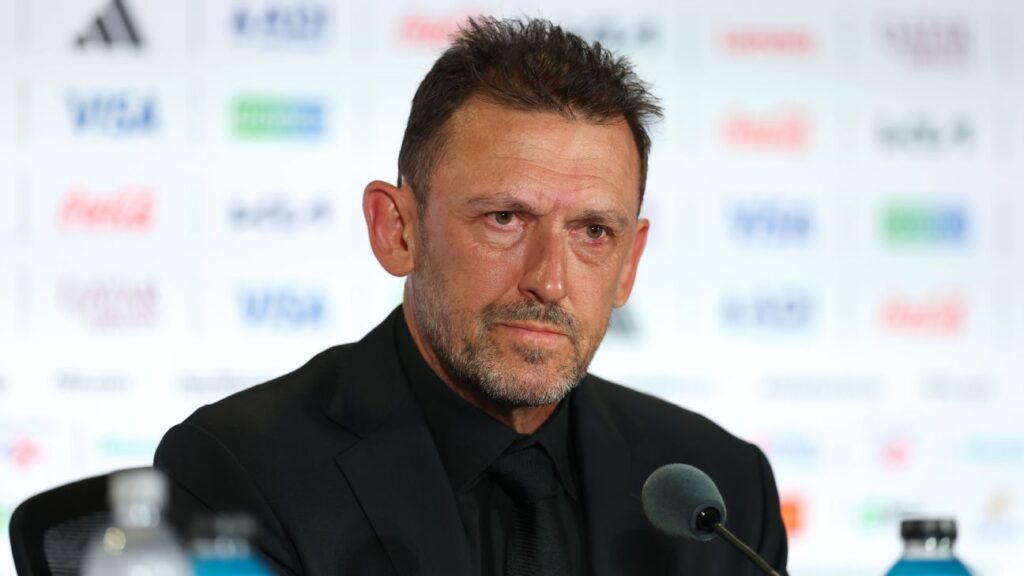
SANTA CLARA, California – Tony Popovic will be forced to make at least two changes to his starting XI after Jacob Italiano joined Mathew Leckie in being ruled out of the Socceroos’ crunch clash with Paraguay, but the coach has kept tight-lipped on whether Nestory Irankunda will return to his lineup.
After Leckie was officially ruled out with a hamstring injury the day prior, Popovic confirmed on Wednesday that Italiano would be absent against the Paraguayans with a groin injury suffered in training.
Without a second natural right wing back in the 26-player squad, it means that the Socceroos will need to turn to Jason Geria or Kai Trewin, both converted centre backs (although Geria did play on the right side of a four in his younger days), or perhaps even Aziz Behich, a left back, to fill the void.
– Inside the Socceroos’ plans to make history in the World Cup knockouts
– Paul Okon flags changes to Socceroos lineup vs. Paraguay
– 2026 World Cup: How teams can advance to the knockout rounds
“Jacob, unfortunately, won’t be available,” said the coach. “I think it’s an adductor injury. We don’t know the extent of it as yet. We’ll do some further tests in the coming days, but he won’t be available for this game.”
Leckie’s absence, meanwhile, will force Popovic to make at least one change to his attack, with pressure also on the place of Nishan Velupillay after his substitution at halftime of last Friday’s 2-0 defeat to the United States.
Irankunda and Connor Metcalfe, both goal scorers in the campaign-opening 2-0 win over Türkiye, would shape as being in line for a recall, as would Cristian Volpato after his strong performance off the bench after replacing the injured Leckie.
In the midfield, both Aiden O’Neill and Paul Okon Jr. have started the first two group stage fixtures, but veteran Jackson Irvine or Hearts terrier Cameron Devlin are waiting in the wings should the coach want to mix things up.
Led by a chorus of former Socceroos, there has been significant clamour for Irankunda and Volpato to see the field, together, against the Paraguayans, but, as his assistant Paul Okon did the day prior, Popovic kept his cards close to his chest when pressed on Irankunda.
“People are happy if a player plays, and people are unhappy if they see a player they like who doesn’t play,” said Popovic. “We played nine players that played the first match; only two didn’t play, so we’re more disappointed in the performance, not so much in who played and who didn’t play. We improved that performance in the second half, which really pleases us. And the players that came on made an impact.
“Whoever starts tomorrow, I know, can build a strong foundation. And whoever comes on can come on and finish what we’ve started. I’m happy with all the players. Each circumstance and situation is very different. We’re very comfortable with the players we chose against the U.S. I wouldn’t change that. I’d only change the performance in the first half, where we could match them a bit better.
“But I’m sure from that experience, we’ll be better against Paraguay, god willing, we get through, we’ll be better again for the next experience. And Nestor plays a big part in that, of course.”
The equation for Australia is simple heading into Thursday’s [Friday AEST] clash: get a point, and they’ll finish second in Group D and head to Dallas to face Group G’s runner-up on July 3. Lose, and they’ll first face a nervy wait to see if they progress as one of the eight-best third-placed finishers, and, if they do that, they’ll likely face Germany in Boston on June 28. Paraguay, meanwhile, must win to avoid a potential date with Die Mannschaft.
The Socceroos organised friendlies against both Venezuela and Colombia last November to prepare for potential South American foes at the World Cup, losing both (which continued a miserable record of nine wins from 50 games against opposition from the continent) but giving debuts to Patrick Beach, Trewin and Okon Jr.
“It’s a different type of opposition [than] we’ve faced so far in Turkey and the U.S., and now Paraguay,” said Popovic. “They’re different styles of play.
“We understand what they bring. They bring a real toughness. Their qualification in South America is very difficult. They know how to get a result. They showed that in the last match, scoring early, 10 men, and they were really resilient and tough. They have a fantastic manager [Gustavo Alfaro], a lot of experience, and it’s a wonderful challenge.”