
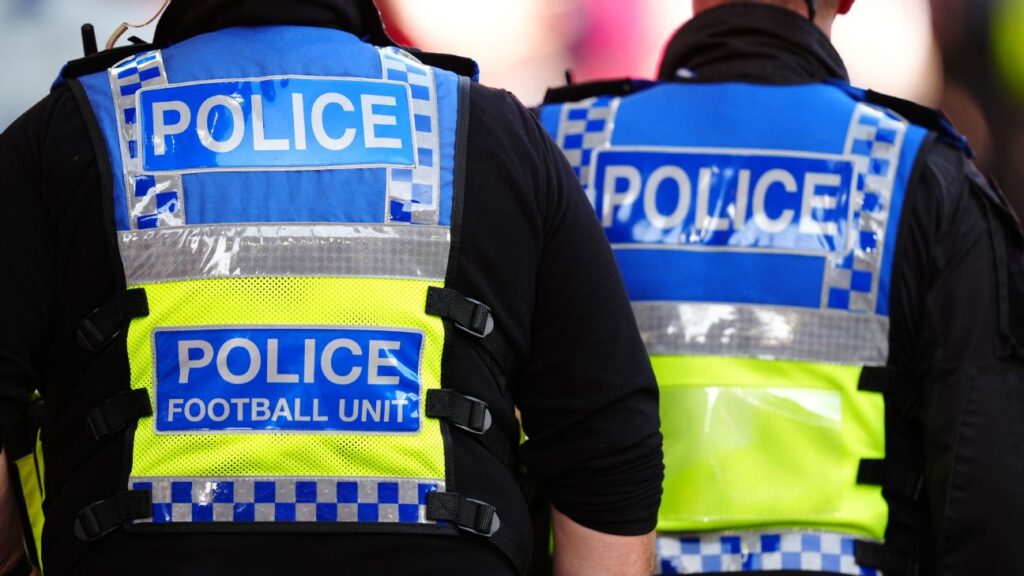
Clubs must shoulder more of the cost for policing outside stadiums, the UK’s football policing lead has said.
Chief Constable Mark Roberts of Cheshire Police said the current model of funding — under which he said £70 million ($93.4m) of the cost falls on taxpayers — “doesn’t work” and “simply cannot continue.”
His comments came on the day the Home Office announced incidents were reported at 1,644 matches in England and Wales during the 2025-26 season — which he said was the highest figure since the UK Football Policing Unit (UKFPU) started collecting the data in 2017-18.
“We will continue to work with our partners including the Crown Prosecution Service, Premier League, EFL and FA to collectively make football a safe environment for the overwhelming majority of supporters who just want to enjoy the game,” Roberts said.
“However, a key part of this is looking at the funding provided to police forces by football clubs as the current model simply doesn’t work.
“Football-related crime doesn’t simply stop when fans exit the stadium, but under the current system multi-billion-pound football clubs do not have to pay a penny towards the policing outside their grounds.
“This means that taxpayers are left footing the £70m ($93.4m) bill each season, which simply cannot continue.”
The Premier League and the EFL have been contacted for a response to Roberts’ comments.
For the 2023-24 season, football clubs covered £14.87m ($19.84) of the total policing cost, with taxpayers picking up the £56.82m ($75.8) remainder, according to UKFPU figures.
– Meet Liverpool’s new boss: Iraola opens up on vision to unite Anfield fanbase
– Did World Cup help or hinder your Premier League team? How tournament affected each club
– Premier League 2026 summer transfers: All confirmed ins, outs for every club
The Home Office figures published on Thursday found there were 2,460 banning orders in force as of June 1, 2026, the highest since the end of the 2011-12 season.
There was also a 73 per cent rise in the number of online hate and abuse incidents in 2025-26 compared to the prior season — 405, up from 234.
Football-related arrests and police actions (1,963) were down by two per cent on the previous year, with 45 of those arrests made for unauthorised entry, which became a Schedule 1 offence under the Football Spectators Act 1989 on March 22 this year.
This is the second consecutive season where the number of arrests has fallen. There was a 59 per cent increase in the number of football-related arrests between the last season before the Covid-19 pandemic — 2018-19 — and the first full season after it — 2021-22.
West Ham remained the club with the highest number of banning orders in force — increasing from 112 to 121. Manchester City were the club with the highest number of arrests (102), followed by Chelsea (76), Manchester United (67), Arsenal (66), Millwall (63).